
for / pourDakar 2026
The Mamelles lighthouse, Dakar
The contemporary African boubou in the visual universe of the Youth Olympic Games.
For the official film of the Dakar 2026 Youth Olympic Games, MWAMI dressed the film's fencers in boubous of silk shantung from Harmattan, the house's continuing chapter. The Games have now closed. This is a record of that contribution, and of the garment at the centre of it.
Dakar 2026
On 31 October 2026, Senegal opened the fourth Summer Youth Olympic Games at the Stade Abdoulaye Wade in Diamniadio. It was the first Olympic sporting event ever held on the African continent. For two weeks, some 2,650 athletes aged 15 to 18, from 204 National Olympic Committees and the first Youth Refugee Olympic Team, competed across three host areas: Dakar, Diamniadio and Saly. The motto was Africa welcomes, Dakar celebrates.
The Games had been a long time coming. Dakar was chosen in 2018 to host them in 2022, and the edition was moved to 2026 during the pandemic. When the closing ceremony was held at the Youth Olympic Village on 13 November, the last finals of the programme had been fought that same day, fencing among them.
The organising committee released its official film in June 2025, at 500 days to go. It moves through the three host sites with young athletes from across Senegal, and features Amadou Dia Ba, silver medallist in the 400 metres hurdles at Seoul 1988. Its title calls it a declaration of love to sport, to youth and to Africa.
In the film
The film was published by the Dakar 2026 Organising Committee. MWAMI's part in it was precise: the house dressed the fencers. Their boubous were cut from silk shantung in the MWAMI atelier in Dakar, from the Harmattan chapter, one in silver and one in orange, each split by a dark band that runs from waist to hem. The rest of the film's wardrobe, and the film itself, belong to its production.
The two fencers meet on the gallery of the Mamelles lighthouse, high above the city, once at dusk and again at night with the lamp lit. They wear the white jacket and the mask of their sport over the boubou. Above the waist, regulation kit. Below it, cloth to the ground.
The pairing is a deliberate one. Fencing is a sport of narrow lines and exact distance, of a body made as small a target as possible. The boubou works the other way. It surrounds the body with cloth and lets the cloth carry the movement. On a fencer, every lunge and every recovery is seen a second time, in the fabric.
Fencing is a discipline of narrow lines and exact distance. The boubou is mostly air and cloth.
The boubou, reconsidered
In Dakar the grand boubou, mbubb in Wolof, is worn to Friday prayer, to weddings, baptisms and Tabaski, and on ordinary afternoons. Its construction is simple: a wide length of cloth folded at the shoulder, opened at the neck, closed at the sides. Everything else is proportion, cloth and embroidery, and that is where a house can work.
MWAMI returns to the boubou across its Harmattan chapters, named for the dry wind that crosses the Sahel each winter. It has appeared as a cape, as a kaftan, in lace, in cotton and in silk. The logic stays the same, a garment that dresses the body by surrounding it. What changes is the proportion: a cleaner neckline, an opening set for movement, a weight of cloth chosen for how it falls.
Silk shantung is woven from uneven, slubbed yarn. It has a dry sheen and an irregular grain, and it holds a shape without stiffness. In a boubou it keeps its volume while the hem follows the body a beat late. That delay is what a camera picks up. MWAMI names its shantung colours after places, Cocody, Plateau, so that the cloth carries an address as well as a shade.
Behind the scenes
Brainstorm Studio (brn.strm), the agency behind the styling and art direction of the shoot, photographed the days around it: the fencers between takes on a rooftop above the city, masks under the arm, and the lighthouse gallery seen from below. They also filmed the short clips.


Watch the film
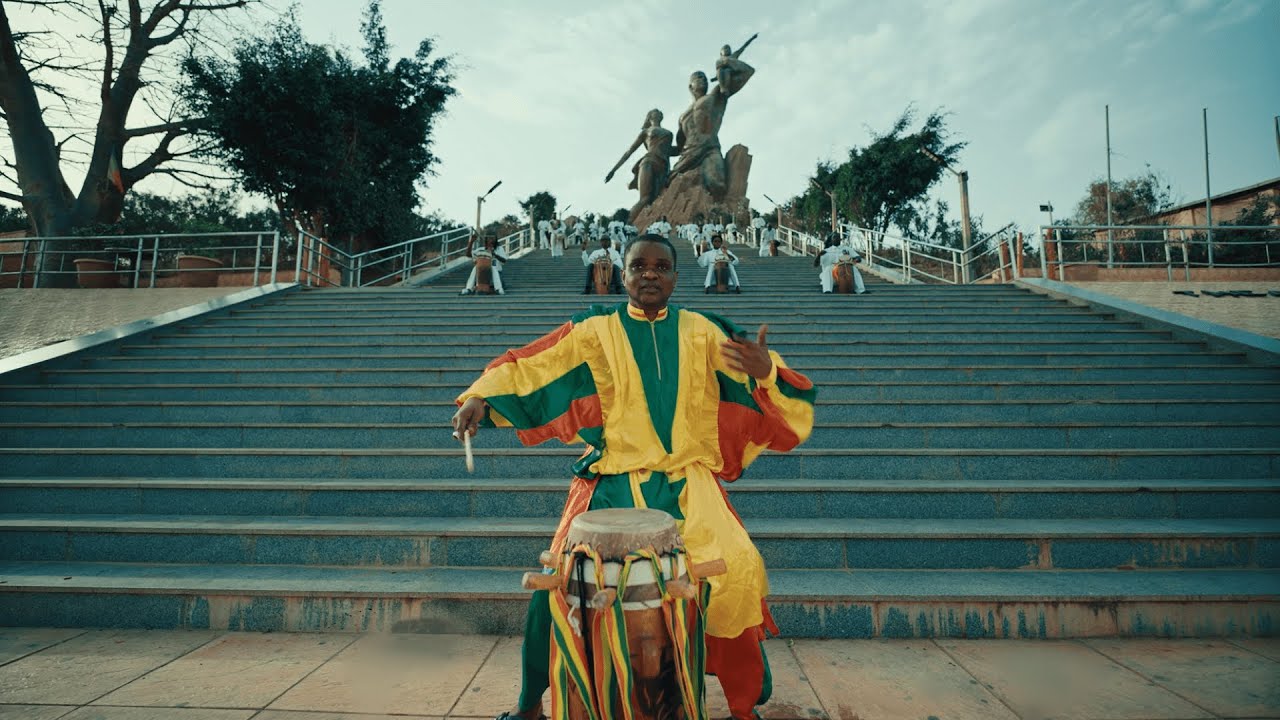
The official Dakar 2026 film, as published by the Organising Committee. The fencers appear in MWAMI.
From the atelier
The pieces below come from the same Harmattan chapter and the same atelier. The Plateau silver boubou is cut from the same silver shantung the fencer wears in the film. Boubous are made to order or to measure in Dakar. For a commission in a specific shantung, or a fitting at the showroom, write to us.
Discover MWAMI


Made to order or to measure in our Dakar atelier. Commissions and showroom visits by appointment.
Contact the atelierShop HarmattanCredits
- Film
- Official film of the Dakar 2026 Youth Olympic Games
- Published by
- Dakar 2026 Youth Olympic Games Organising Committee (COJOJ)
- Fencers' garments
- MWAMI, Harmattan chapter
- Creative direction, MWAMI
- Papi Wata
- Made in
- MWAMI atelier, Dakar
- Styling and art direction
- Brainstorm Studio (brn.strm)
- Behind the scenes photography and clips
- Brainstorm Studio (brn.strm)
- Location
- Mamelles lighthouse, Dakar
Join our newsletter
New chapters, stories from the atelier and first access to pieces made in Dakar.